

With the project
finally green-lighted, filming commenced Monday, February 9, 1987. A
majority of the movie was filmed in and around Scottsdale, Arizona in Maricopa
County, adjacent to Phoenix. The area afforded the filmmakers a more
scenic ambience than they could have obtained shooting in and around San Dimas
(and undoubtedly Arizona was more affordable.) A company called B&T
Productions Limited was set up at the Apache Business Plaza in Tempe, Arizona
(now abandoned) as a center for all of the production coordination. Script
revisions were distributed to the cast and crew by Patty Whitcher, Production
Coordinator, from this office. The revised
production schedule had the shoot lasting from February 9, 1987 until the end of
March, but it appears that principle filming in the area continued until early
April. The cast and crew stayed at local hotels . . .
call sheets
from the shoot indicate that select cast members stayed at the Scottsdale Cottonwoods
Resort and Inn while the rest of the cast stayed at the Holiday Inn. While
some the 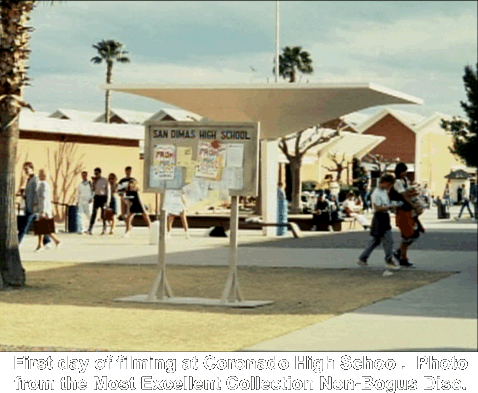 principal actors and crew were picked up in private cars and buses at their hotels, shuttles were arranged to leave from both locations on most days to deliver
the other cast
and crew members to the various locations in and around Scottsdale.
principal actors and crew were picked up in private cars and buses at their hotels, shuttles were arranged to leave from both locations on most days to deliver
the other cast
and crew members to the various locations in and around Scottsdale.
The first scenes to be filmed were the exterior school parking lot scenes and exterior school library scenes at Coronado High School, much of which ended up on the cutting room floor. In an exclusive interview with this website, Will Robbins, who played the unforgettable Ox ("San Dimas High School Football Rules!") recalls how he became involved with the project. "I was in school at ASU, doing the usual crazy college kid thing. I am from Scottsdale so I didn't have to travel to far to go to school. I wasn't paying to much attention to the books when I read for B&T. A family friend called my sister to audition for one of the cheerleaders. My mom had asked If I could drive my sister Laura to the audition, and while I was there one of the casting people told me I look like an "OX". I wasn't sure what she had meant till I read for the part. I ended up reading a few times for Steven Herek, and some 6 months later I was told I got the part. My sister is still mad at me. Oh, and I should say that the family friend is Gay Gilbert local casting agent in Arizona, one of the nicest people you will ever meet."
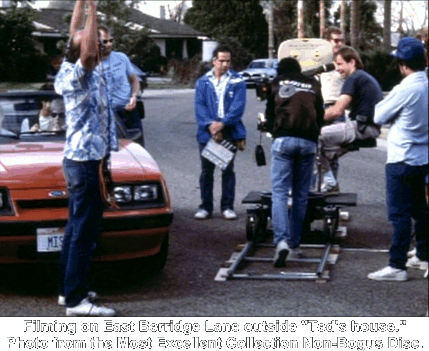
Ox went on to explain, "We had one scene at the start of the film where we confront Bill and Ted in the parking lot of school, and push them around and make fun of them, etc." This is what was filmed on the first day of production. While the production schedule gives us an idea what was planned to be filmed and when, changes were inevitable, as seen by the call sheets. There are always delays when making a film, either caused by weather, uncontrollable circumstances or scenes which take longer than expected so subsequent scenes need to be pushed back to another day. Everything considered, it appears the movie did not run an exceptionally long time over schedule. The script was still a work in progress during filming, with changes taking place as they went along. Most of the missing footage from this film was of scenes later redone in another way (i.e. Bill & Ted originally argued about what they needed for Wyld Stallyns on the school bus instead of Bill's garage, and the final report originally was filmed as taking place in a classroom and not in the auditorium.) Revised script pages were provided to the cast and crew throughout the filming from the production office. Earliest production schedules and even call sheets still referred to Captain Logan as Captain Williams!
Roy Forge Smith, who had previously worked with
Monty Python on the Holy Grail film, was the production designer for the
movie. He was key in helping to create the authentic look of the time
periods with a rather limited budget while maintaining the humor
throughout. He recalled the filming was tough 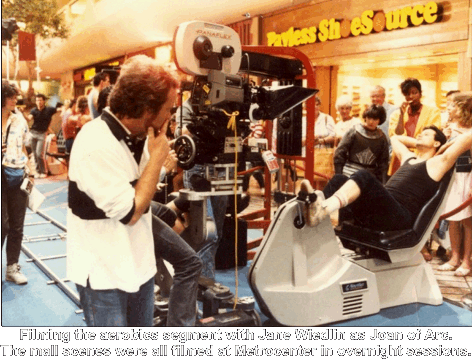 because they were working
long hours and trying to make it all happen with a limited budget. Barry
Nolan, the director of special visual effects for the film, explained their
special effects budget was around $500,000. He told Starlog Magazine in
1988, "There are a few tricky shots, but most of it isn?t horribly
difficult. We?re doing matching motion-control shots, to be matched
later with film from the first unit, and we?ve done some interesting things
with the circuits of time. It?s very dynamic ? it?s motion and speed
that the audience can hopefully feel in the seat of their pants! The
circuits of time are transparent glass tubes, rather organic-looking ? like an
ocean of undulating worms. The oceans above and below are constantly
moving as we fly in the criss-crossing tubes. The circuits of time
themselves are being done digitally. The phone booth comes out of the
sky. We have a 16-inch miniature with all of the characters in
miniature. There?s a six-inch booth that will all be done
motion-control. We do a few close-ups of the booth landing ? it just
drops into frame with real tight shots. All the other arrivals and
departures will be done in miniature. The Dome will feature several large
matte paintings. There will be a great deal of effects work entering the
Dome ? the transformation of the phone booth as it arrives, and its
departure. Part of the sequence will be done in miniature, which is being
built back in L.A. The rest will be live-action, with a combination of
miniatures, very heavily augmented with FX animation."
because they were working
long hours and trying to make it all happen with a limited budget. Barry
Nolan, the director of special visual effects for the film, explained their
special effects budget was around $500,000. He told Starlog Magazine in
1988, "There are a few tricky shots, but most of it isn?t horribly
difficult. We?re doing matching motion-control shots, to be matched
later with film from the first unit, and we?ve done some interesting things
with the circuits of time. It?s very dynamic ? it?s motion and speed
that the audience can hopefully feel in the seat of their pants! The
circuits of time are transparent glass tubes, rather organic-looking ? like an
ocean of undulating worms. The oceans above and below are constantly
moving as we fly in the criss-crossing tubes. The circuits of time
themselves are being done digitally. The phone booth comes out of the
sky. We have a 16-inch miniature with all of the characters in
miniature. There?s a six-inch booth that will all be done
motion-control. We do a few close-ups of the booth landing ? it just
drops into frame with real tight shots. All the other arrivals and
departures will be done in miniature. The Dome will feature several large
matte paintings. There will be a great deal of effects work entering the
Dome ? the transformation of the phone booth as it arrives, and its
departure. Part of the sequence will be done in miniature, which is being
built back in L.A. The rest will be live-action, with a combination of
miniatures, very heavily augmented with FX animation."
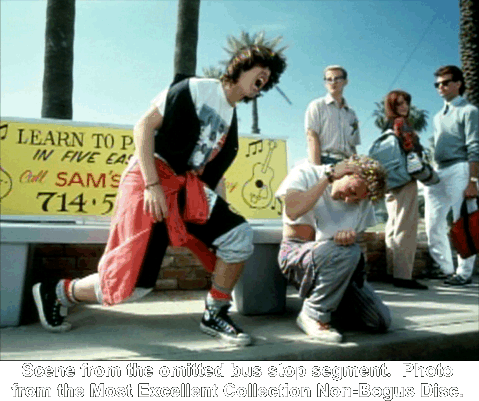
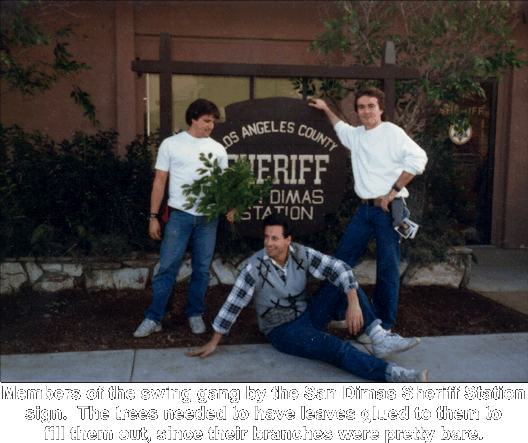
Because of the limited budget, the crew sometimes had to make do with what they could to make magic happen . . . real old-fashioned smoke and mirrors filmmaking. Jim Meyer, a member of the film?s swing gang, remembered working on the dome set, explaining that they spent hours and hours pasting up the little metallic-looking triangular pieces that made up the interior of the dome. He also recalled gluing leaves to the bare branches of the bushes outside the police station, since there was no foliage on them at the time! Many times an actual phone booth, or at least half of one, was hoisted on a crane and lowered to simulate the booth dropping from the sky, with the special effects added afterwards. Many scenes were filmed at night, including overnight shoots for all the mall footage. Obviously the Circle K scenes and those at Ted's house were also done at night, and the cast and crew were urged to keep the noise down on the set while filming in the residential neighborhoods in the early morning and evening hours. Hot lunches and box lunches were also provided to the cast and crew during the shoots.
 Will "Ox" Robbins
was happy to report, "Alex and Keanu were terrific, I actually got them to go out to a few local
college bars
and even though the college crowd was not their 'scene' we had a good
time anyway. I also had just bought a new motorcycle that was close to the same model Keanu
had
at home, so he spent a bit of time riding around the lot, until production got
wind and
pulled him off the bike. They were just like many of us at that age, having a
good time,
enjoying what was going on around them. Nice people over all."
Will didn't get to work with George Carlin, but he explained, "I did get a chance to have a few drinks with him and the crew at the swanky
Holiday Inn on Mill Avenue." Even with
long workdays, the cast and crew obviously still made time for some fun! On
one of the call sheets was written the note: "Crew
Blues Note: Sat. Nite: Tony?s New York Lounge;
Chuck Hall & The Brick Wall; 1 block west of Mill on Broadway; Be there or
be square." One very funny aspect of the call sheets was the
"Quote of the Day," in which various quotes overheard from the cast
and crew were recounted and shared with all. Here are a few examples
[parts in brackets are our annotations]:
Will "Ox" Robbins
was happy to report, "Alex and Keanu were terrific, I actually got them to go out to a few local
college bars
and even though the college crowd was not their 'scene' we had a good
time anyway. I also had just bought a new motorcycle that was close to the same model Keanu
had
at home, so he spent a bit of time riding around the lot, until production got
wind and
pulled him off the bike. They were just like many of us at that age, having a
good time,
enjoying what was going on around them. Nice people over all."
Will didn't get to work with George Carlin, but he explained, "I did get a chance to have a few drinks with him and the crew at the swanky
Holiday Inn on Mill Avenue." Even with
long workdays, the cast and crew obviously still made time for some fun! On
one of the call sheets was written the note: "Crew
Blues Note: Sat. Nite: Tony?s New York Lounge;
Chuck Hall & The Brick Wall; 1 block west of Mill on Broadway; Be there or
be square." One very funny aspect of the call sheets was the
"Quote of the Day," in which various quotes overheard from the cast
and crew were recounted and shared with all. Here are a few examples
[parts in brackets are our annotations]:
Monday, February 9, 1987 - "Be Excellent to Each Other" - Rufus
Tuesday, February 24, 1987 - "I hate nature!" - Tim Suhrstedt [Cinematographer] noted D.P. / Environmentalist
Saturday, February 28, 1987 - "As soon as you sit . . . we?re outta here." - Bob Field [2nd electrician] in Mike Puzzuto?s [Extra Grip] dream
Also: "How long is it going to take?" - Lady Driver & Lady 1st A.D.
Wednesday, March 4, 1987 - "Why do we never have enough spoons?" - Sigmund Freud
 Monday, March 9, 1987 -
"Production is the toilet paper of the set, but no one can "lay
cable" without us." - Janet Elsasser [Production Assistant]
Monday, March 9, 1987 -
"Production is the toilet paper of the set, but no one can "lay
cable" without us." - Janet Elsasser [Production Assistant]
Tuesday, March 10, 1987 - "F? the planes, we?ll loop it." - Steve Herek after 31st crop duster of the morning
Thursday, March 12, 1987 - "We?ve already dropped quite a load here." - David Linck our cerebral publicist noting the money already spent by company in Phoenix
Friday, March 13, 1987 - "It?s not Metrocenter . . . It?s . . . METRO HELL." - Connie Hoy [Production Assistant]
Saturday, March 14, 1987 - "Is Tony Steedman picture ready?" - Eric Heffron [Second Assistant Director] inquiring about his status seven takes after he?d been on set
Monday, March 16, 1987 - "There was no quote o? the day today! Fill in yourself!" (Written in pen: "Larr, Wally, Jim, I mean Dan, come here!")
Tuesday, March 17, 1987 - "Why is this taking so long?" - Owner of Ted?s house
Thursday, April 2, 1987 - "There?s no one left to blame." - Anonymous
The infamous prom scene, which
marked the original end of the film, was filmed but never used. Will
"Ox" Robbins explains, "We were not used in
the 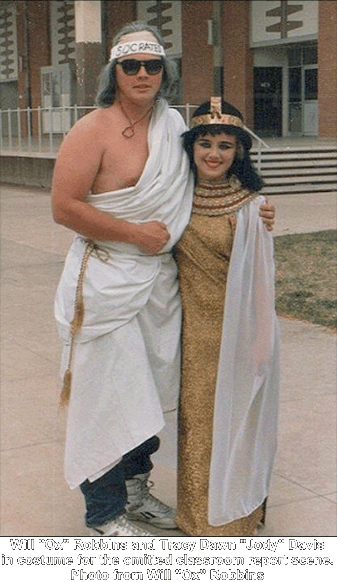 prom scene, and I had only heard about it from a friend who was an extra that
day." George Carlin, of course, was present for the filming of this
scene as well. Regarding the comedian's work on the film, Stephen
Herek remarked, "George has been great! This is
his third film, and he?s really serious about trying to become an actor,
rather than just a stand-up comedian. George works harder than anybody I?ve
ever seen as an actor. He?s a consummate professional. We have
talking about everything ? delivery of his lines, his mannerisms ? he has
been a total joy. We?ve given him a new look ? he?s not very
hippy-dippy weatherman any more. This is the 1980's George Carlin and that?s
what?s exciting." George Carlin summed up his part this way:
"I guess Rufus is what you would call the embodiment of total elapsed rock
and roll coolness." An interesting note is that George Carlin's
daughter reportedly was one of the futuristic "domeheads" (as the
people in the future referred to during shooting.)
prom scene, and I had only heard about it from a friend who was an extra that
day." George Carlin, of course, was present for the filming of this
scene as well. Regarding the comedian's work on the film, Stephen
Herek remarked, "George has been great! This is
his third film, and he?s really serious about trying to become an actor,
rather than just a stand-up comedian. George works harder than anybody I?ve
ever seen as an actor. He?s a consummate professional. We have
talking about everything ? delivery of his lines, his mannerisms ? he has
been a total joy. We?ve given him a new look ? he?s not very
hippy-dippy weatherman any more. This is the 1980's George Carlin and that?s
what?s exciting." George Carlin summed up his part this way:
"I guess Rufus is what you would call the embodiment of total elapsed rock
and roll coolness." An interesting note is that George Carlin's
daughter reportedly was one of the futuristic "domeheads" (as the
people in the future referred to during shooting.)
Will "Ox" Robbins explained the major change in the final report scene, which was shot two different ways. "The original ending had us giving our speeches in the classroom which was funny. But the writers came back a few weeks later and decided to put more production into the scene, added some concert lighting and props. Which gave them a chance to do more with the historical dudes, and make it a much bigger ending. In example, Genghis (Al Leong) would not have been able to do his martial arts display, as well with Joan of Arc (Jane Wiedlin)." During the filming of the history report segment in the auditorium, Keanu Reeves took time to speak with Starlog Magazine. "This has been a great deal of fun. Ted really likes this. This final exam scene is his fantasy, with all of these cool special lights ? it?s the culmination of all of his and Bill?s efforts. All of the time travel is sideline to the people in the film. It?s not ?And here?s a special effect! It?s like ILM, with blues and reds and brawkk!," he gestures wildly. "These are earthy, homey special effects, which I?m looking forward to seeing." When asked if he enjoyed being in a fantasy film, Keanu replied, "Please! I?m having the best time! I?m playing a guy who?s so insouciant, a naive child of the woods, that it?s fun and cleansing. And then to meet all these cool people!" Keanu told another teen magazine, "Ted has invaded my life. I love this guy. You know, 'cause he's such a nice guy and he's a character where I get to smile a lot."
Keanu explained his off-screen relationship with Alex while filming, "We work with each other all day and occasionally go out with the crew, but we basically only have each other to hang out with, and not go stir-crazy at night. It?s very fortunate we like each other ? if we didn?t, filming would be hell. Spending time together has certainly helped the work." When Keanu was called back to work, he had to summon up his adrenalin to get back into the filming. He explained, "Ted is hard when I don?t have the energy, and I sometimes find myself commenting, in my performance, on Ted. There are certain things Ted would do that almost become self-conscious. I don?t know if that translates well, but that bothers me. Being consistent can be difficult, and getting the energy to bring out Ted has been the challenge ? keeping up the energy, honesty and that whole look ? it?s hard to be a child of the woods in these times!"
 Stephen referred to this
boundless energy as the "puppy factor" when describing Bill and Ted, and
especially Ted. He explained that they would be like big Labrador Retrievers who just bounce along and
love life, and in directing them would say, "There?s not enough puppy
factor," to get them to make things even bigger and happier and
bouncier. Originally Ed and Chris had actually envisioned Bill & Ted
as a darker kind of movie, more in line with the Monty Python films. This
was evident in the sequel, Bogus Journey. But Stephen was
determined to keep the project light and happy and the energy and enthusiasm up,
which enveloped the cast and crew. Most everyone who worked on the movie
has said it was one of the most pleasurable experiences of their careers.
Stephen referred to this
boundless energy as the "puppy factor" when describing Bill and Ted, and
especially Ted. He explained that they would be like big Labrador Retrievers who just bounce along and
love life, and in directing them would say, "There?s not enough puppy
factor," to get them to make things even bigger and happier and
bouncier. Originally Ed and Chris had actually envisioned Bill & Ted
as a darker kind of movie, more in line with the Monty Python films. This
was evident in the sequel, Bogus Journey. But Stephen was
determined to keep the project light and happy and the energy and enthusiasm up,
which enveloped the cast and crew. Most everyone who worked on the movie
has said it was one of the most pleasurable experiences of their careers.
Alex Winter took a break from sword-fighting with Jane Wiedlin to offer his opinions to Starlog Magazine as well. "Everyone does have a very distinct character, whatever their traits ? this movie really does focus on people as people. That?s what makes our parts so interesting. We had to develop these solid characters because they?re exposed at every angle. Bill lives in his own world. He?s pretty different from myself, but he?s fun to play. He?s someone who just lets loose completely, constantly escapes to his fantasyland ? completely oblivious to the outside world. My favorite scene has been the Western town ? we have a poker game with Billy the Kid and a group of old cowboys. We?re blatantly, openly cheating, and it erupts into a barroom brawl. "I would walk through town, and there were cowboys all around ? these guys are from Phoenix, they?ve all got guns, and they go home looking the same way they do on the set. When they cock and aim their guns, that fine line between fantasy and reality is broken. I definitely wasn?t thinking about what I had for breakfast that morning ? it got me into character pretty fast! Just before Alex returns to film the scene with Napoleon and the Risk board, he added, "I?ve always wanted to shoot a Western scene strolling through town, walking through the bar doors, and having everyone stop and look at me as I order, ?Two beers!? It?s something I?ve always wanted to do. It?s a shame I had to do it as a complete bonehead, but it was still fun. It?s rare to find a comedy that?s actually funny!" Alex told another teen magazine, "This is a comedy and the last movie I did (The Lost Boys) wasn't that funny. It was pretty evil. This guy is sort of the opposite: blissful, innocent, happy, completely unjaded. This is actually one of the only things I've done where I'm not a villain, so it's a lot of fun."
Stephen Herek?s take on the
lead characters was this: "Bill and Ted are guys that really are pretty endearing
guys. I think what?s infectious about both of them is how much energy
and how they seem to look at the world through innocent eyes." On the
film itself , he says, "I described it as like a rock and roll 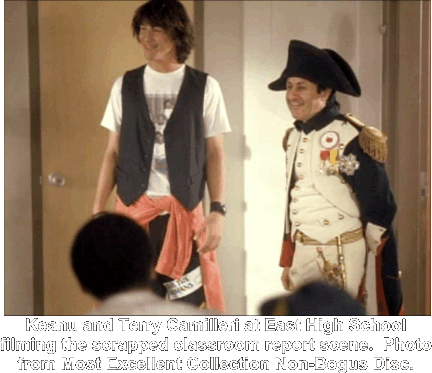 fairy tale
and basically a comedy for all ages. It?s a lot like Monty Python, sort
of like Fast Times at Ridgemont High meets Back to the Future.
A crazy thing." In 1988, he told Starlog Magazine: "It?s the
relationship between Bill and Ted. That?s what I really got caught up
in, how symbiotic they were. They?re like right and left ? we can?t
have one without the other. It?s a nice friendship."
fairy tale
and basically a comedy for all ages. It?s a lot like Monty Python, sort
of like Fast Times at Ridgemont High meets Back to the Future.
A crazy thing." In 1988, he told Starlog Magazine: "It?s the
relationship between Bill and Ted. That?s what I really got caught up
in, how symbiotic they were. They?re like right and left ? we can?t
have one without the other. It?s a nice friendship."
The supporting cast also enjoyed playing their respective parts and took their work very seriously, lending an air of dignity to what could have been a very campy affair in the wrong hands. On his character, Sigmund Freud, Rod Loomis told Starlog Magazine in 1988, "Call me Siggy. His mother called him ?Mein Goldener Siggy.?" Loomis had done extensive research on Sigmund Freud for the film. "I wasn?t looking for his theories, but for the man himself ? physical characteristics and attitudes that I would be able to transfer on film. Little things, like he was a ring-twister, he played with the rings on his hand. Freud was addicted to nicotine and smoked cigars constantly, which I?m going to suggest at the beginning of my scenes, but I didn?t want to have to carry it all the way through. When I?m picked up by the boys in Vienna, I come out of the office into the street, smoking a cigar. There?s also a scene at the mall where I get to eat a hot dog, which is kind of funny. Rather suggestive, too."
Clifford David also talked to
Starlog about his role as Beethoven. The reporter noted how authentic his
costume looked, even up close. When asked about Beethoven being a pop
star, he responded, "It fits in with the time. For me to be archaic
and historical in this setting would destroy the scene?s intention. If
Beethoven were alive today, he would be in the avant garde of this field.
He would understand the synthesizer and go beyond that, because Beethoven, in
his own time, was shocking." Starlog went on to explain that David
artificially lowered his hearing to help him get into character. The fact
that Beethoven didn?t speak any English is something he also found to be an
interesting challenge. "I thought, ?What an incredible challenge
for me not to speak!? In these scenes, the synthesizer was an
extension of me ? at least, I hope that?s how it comes across ? speaking
through the music and the 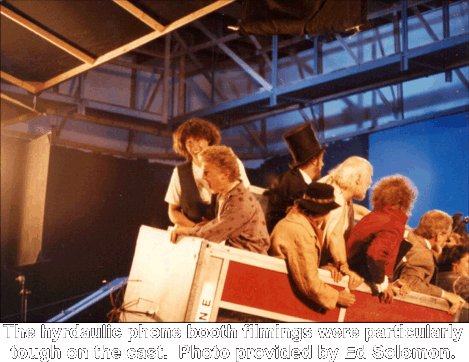 behavior. I was fascinated to see if I could
find the truth of the character without saying a line!"
behavior. I was fascinated to see if I could
find the truth of the character without saying a line!"
It would appear
that filming in
Arizona ended around Friday, April 3, 1987 with the dome scenes at Carefree
Studios and then some exterior mall parking lot shots at the Paradise Valley
Mall (for exterior mall scenes eventually cut from the film). The length of the
entire shoot ended ten weeks later in May after a couple of weeks filming castles
and coliseums in Italy for the historical parts. Herek said, "The
budget was originally $8 million but ended nearer ten - exactly what I thought
it would cost all along." According to Herek, filming went as
planned, too, admitting, "The hardest bit, surprisingly, turned out to be
the ?phone booth. It was a real prop and trying to squeeze all the
actors in was funny at first but then it got really tiresome. ?We?ve
got to get in there again?? they would moan!" Apparently, no one
liked filming in the phone booth, which was hoisted up on a crane for the shots
of it dropping from the sky and also the green screen segments of traveling
through time. The actors pretty much agreed they were very uncomfortable
scenes to film. Alex noted, "While we were doing all the blue-screen
shots, I thought I was going to be thrown out of this giant, motorized phone
booth. It was attached to a hydraulic shifting device ? it?s hard to
act in that kind of environment! I had to focus myself really hard and
pull myself into where I am. I?m in a studio in front of a painted blue
wall, with this metal hydraulic thing whining and groaning under my feet; I?m
bucking like a bronco being tossed around. In the midst of all that, I
have to act!?" But Stephen Herek felt it was important to show the
booth actually traveling through time instead of just leaving one location and
arriving in another. As he explained, "There have been a number of movies and TV series dealing with the same
back to the future idea as Bill and Ted. But this was primarily about their
unexpected fantasy coming true. We knew the special effects would cover us in
key areas, but for the most part we had 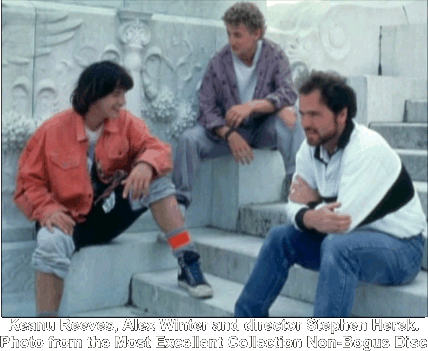 to rely on the actors and technicians to
help the illusions come to life. Luckily, everything ran very smoothly."
These hydraulic scenes were
filmed at Carefree Studios near the end of the filming schedule in Arizona.
to rely on the actors and technicians to
help the illusions come to life. Luckily, everything ran very smoothly."
These hydraulic scenes were
filmed at Carefree Studios near the end of the filming schedule in Arizona.
Filming in Europe turned out to be memorable for much of the cast and crew. Chris Matheson recalled that when they first filmed in Rome, Italy, at first he and Ed weren?t given a per diem, so they would watch the rest of the crew eating their dinners and they would be sitting at the table like peasants, although the per diemed crew did finally break down and give them some of the food. Alex recalled that during the shooting in Rome they put Bill and Ted signs up, so that when they were filming at the Piazza de Venezia, a building no one had been in since Mussolini left power, the police were there and they were filming the Freud and Socrates scenes and the people there didn?t know what was going on. As Alex noted, "It was is if Bill and Ted had invaded Rome."
Finally, director Stephen Herek explained that some second unit waterslide stuff was filmed in San Dimas (at Raging Waters). Scott Kroopf said it was done after the movie was completed just to give the scenes a little better vibe and excitement.
So the filming was completed, the footage was in the can and post-production could begin. But would Excellent Adventure make it to the big screen . . . or would it end up as a straight-to-video release?
GO TO THEATRICAL RELEASE INDEX
Article Sources:
Bill &
Ted's Most Excellent Collection - Non-Bogus Disc: In Conversation with
Screenwriters Chris Matheson & Ed Solomon
Bill & Ted's Most Excellent Collection - Non-Bogus Disc: The Most Triumphant
"Making-of" Documentary
Cinefantastique, August 1991 - Writers Chris Matheson and Ed Solomon on the
birth of a phenomenon
Starburst - May 1990
Production schedule and call sheets provided by Jim Meyer
Go to Excellent Adventure Page
BILL & TED characters are trademarks of Nelson 1991 Inc. The motion picture BILL & TED'S EXCELLENT ADVENTURE ? 1989 Nelson Films Inc. All Rights Reserved. The motion picture BILL & TED'S BOGUS JOURNEY ? 1991 Orion Pictures Corporation. All Rights Reserved.
